Troubleshooting and Maintenance of HPLC Systems: A Biomedical Engineer’s Guide
In the modern clinical and pharmaceutical laboratory, the High-Performance Liquid Chromatography (HPLC) system is the gold standard for separating, identifying, and quantifying components in a mixture. As a Biomedical Engineer who has been managing high-end laboratory diagnostics since 2017, I have seen how even a microscopic bubble or a slight pressure fluctuation can compromise critical results.
Understanding the fluidics and high-pressure mechanics of an HPLC is essential for ensuring the accuracy of drug testing, vitamin analysis, and specialized diagnostic assays.
1. The Engineering Behind the Separation
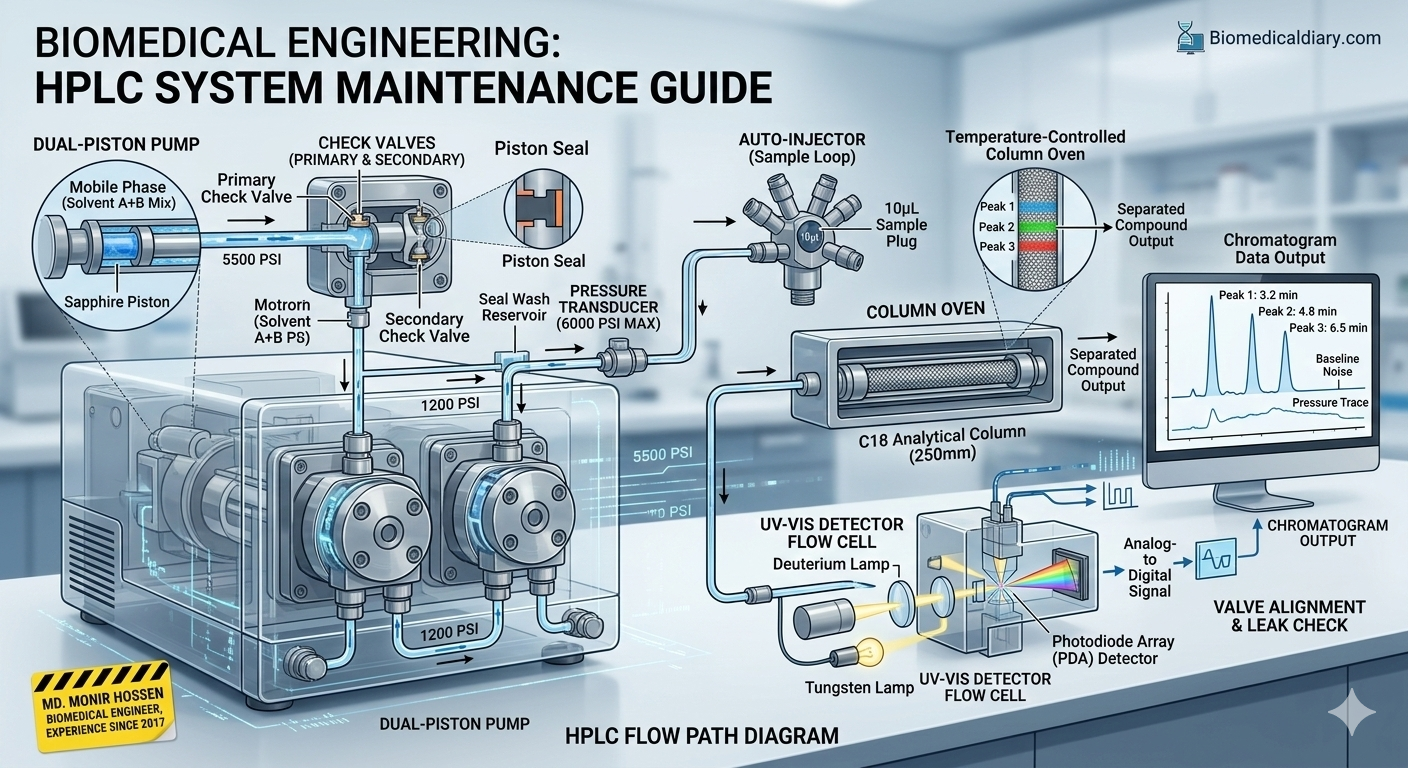
HPLC works by forcing a liquid sample (the mobile phase) through a column filled with a solid adsorbent material (the stationary phase) at very high pressures.
Each component in the sample interacts slightly differently with the adsorbent material, causing them to exit the column at different times (retention time). As an engineer, our job is to ensure that the Gradient Pump and Detector work in perfect synchronization to maintain the integrity of these retention times.
2. Critical Components of the HPLC System
A. The High-Pressure Pump
Modern HPLC pumps must deliver constant, pulse-free flow at pressures reaching up to 6,000 PSI (or much higher in UHPLC systems).
-
Engineering Insight: I have found that most pump failures since 2017 stem from worn-out piston seals or check valve malfunctions.
B. The Manual or Auto-Injector
The injector introduces the sample into the high-pressure fluid stream without depressurizing the system. Precision here is measured in microliters ($\mu L$).
C. The Column (The “Heart”)
The column contains the packing material. It is sensitive to temperature and chemical contamination. Maintaining a stable Column Oven temperature is vital for reproducible results.
D. The Detector (UV-Vis or Fluorescence)
The detector “sees” the components as they emerge. It uses high-precision lamps (Deuterium or Tungsten) and flow cells that must be kept perfectly clean.
3. Common Technical Failures and Engineering Fixes
Error 1: High Back-Pressure Alarms
If the system pressure suddenly spikes, it usually indicates a blockage.
-
Root Cause: Clogged “frits” (filters) in the column or the inline filter, or salt precipitation from the buffers.
-
Engineering Fix: Systematically bypass components (detector, then column, then injector) to find the exact location of the clog. Flush the system with hot deionized water if buffer salt buildup is suspected.
Error 2: “Ghost Peaks” or Baseline Noise
-
Root Cause: Air bubbles in the pump head or contaminated solvents.
-
Engineering Fix: Perform a “Power Prime” or use an integrated Vacuum Degasser. Since my start in 2017, I’ve observed that many noise issues are solved simply by replacing the solvent intake filters (sinkers).
Error 3: Retention Time Shifting
-
Root Cause: Leaking pump seals or fluctuating ambient temperature.
-
Engineering Fix: Perform a Leak Test on the pump heads. If the seals are more than 12 months old, replace them as part of your annual PM (Preventive Maintenance).
4. Professional Calibration and Validation (OQ/PQ)
To ensure the system meets international diagnostic standards, the following must be verified:
-
Flow Rate Accuracy: Measure the actual volume of solvent delivered into a graduated cylinder over a set time (e.g., 5 minutes at 1.0 $mL/min$).
-
Gradient Linearity: Verify that the pump accurately mixes solvents from multiple reservoirs (A, B, C, D) in the correct percentages.
-
Wavelength Accuracy: Use a standard solution (like Caffeine or Holmium Oxide) to verify that the UV detector is reading at the correct nanometer ($nm$) peak.
5. Preventive Maintenance (PM) Checklist
To maximize the lifespan of an HPLC system, follow this professional schedule:
-
Daily: Flush the system with a “seal wash” to prevent salt buildup on the pistons.
-
Weekly: Check for any signs of leaks at the “nuts and ferrules” (connections).
-
Bi-Annually: Replace the lamp if the energy intensity falls below the manufacturer’s threshold.
-
Annually: Replace piston seals, check valves, and the needle seat in the autosampler.
Conclusion: Maintenance is a Science
HPLC systems are sensitive instruments that require a disciplined maintenance approach. Having specialized in laboratory engineering since 2017, I have learned that the best troubleshooting tool is a clean system. By keeping the fluid path free of bubbles and contaminants, you ensure that the machine remains a reliable tool for patient care.
For technical support or service manual requests regarding brands like Agilent, Shimadzu, or Waters, feel free to reach out.
Md. Monir Hossen
Biomedical Engineer
Email: monir@biomedicaldiary.com